

Introduction
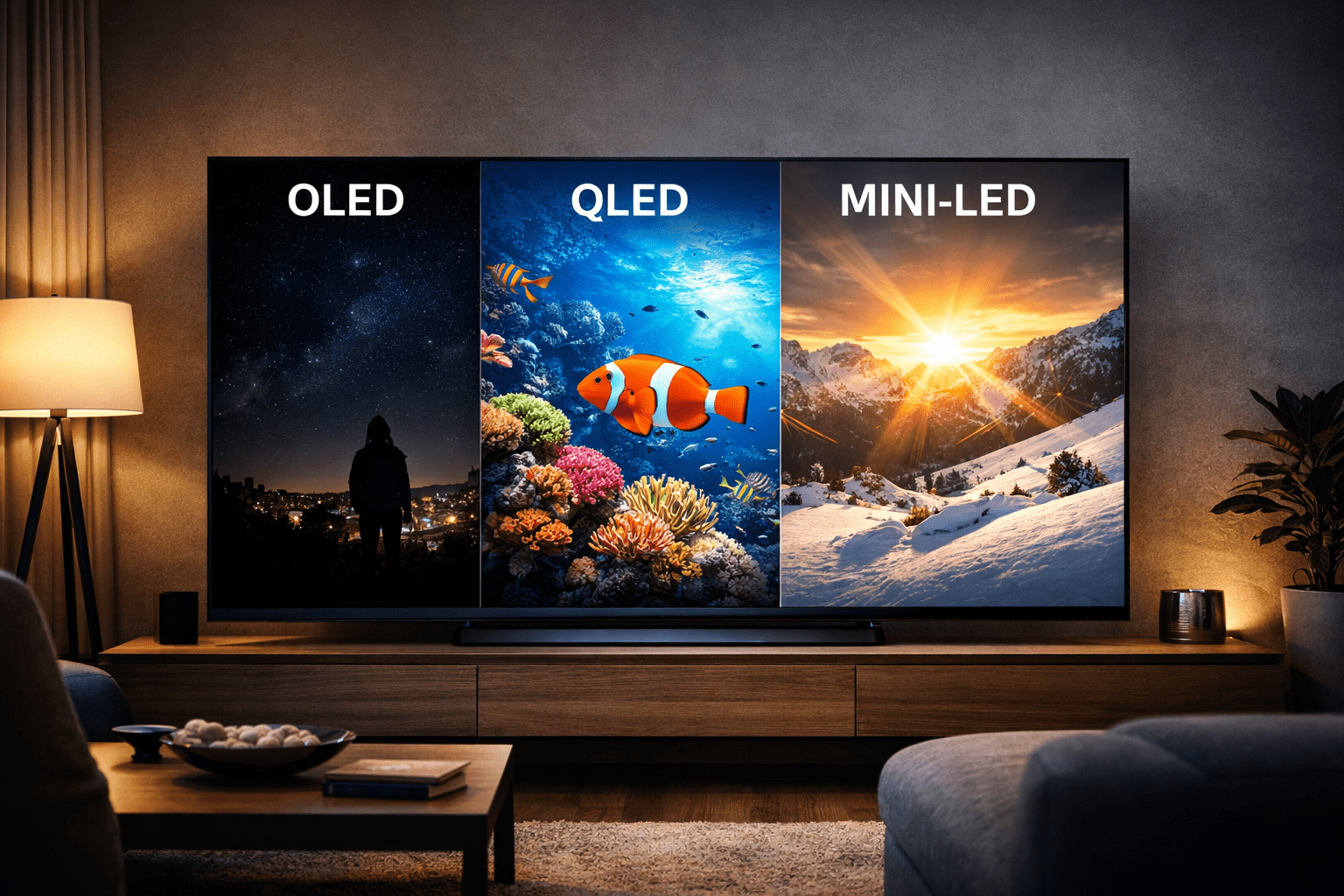
OLED vs QLED TVs are the two most common display technologies you will see when buying a new 55-inch 4K TV. Many buyers also compare Mini-LED TVs, which offer a different balance of brightness and contrast.
A 55-inch 4K TV is a popular choice because it fits well in most homes. It feels big enough for movies, sports, and gaming, but it does not take over the whole room. That is why many buyers compare these three display types before making a final decision.
This guide explains OLED vs QLED vs Mini-LED TVs in clear and simple language. It will help you understand which one is best for picture quality, brightness, gaming, movies, and value.
Why This Comparison Matters
Not every TV is made for the same type of viewer. Some people want deep blacks and cinema-like picture quality. Others want a bright screen that looks great during the day. Some buyers care most about gaming features, while others just want the best value for money.
Because of that, choosing the right display technology matters more than many people think. A TV can look amazing in one room and only average in another. The better choice depends on your budget, your room lighting, and the kind of content you watch most often.
What Is OLED
OLED stands for Organic Light-Emitting Diode. In an OLED TV, each pixel makes its own light. This means the TV can switch off individual pixels completely when showing black parts of the image.
That one feature gives OLED its biggest advantage. Since black pixels can turn off fully, dark scenes look deep and rich instead of gray. The result is better contrast and a more premium picture.
OLED TVs are often the favorite choice for movie lovers because they make films look more natural and dramatic.
OLED Picture Quality
When people talk about the best TV picture quality, OLED is usually part of the conversation. Its main strength is contrast. Bright parts of the image stand out more because the dark parts stay truly dark.
This matters a lot in movies and high-quality streaming shows. Night scenes, shadows, and small details often look cleaner on OLED. Instead of looking flat, the picture feels more realistic.
Another big advantage is viewing angle. If you sit to the side of the TV, the image still looks strong. Colors stay more stable, which is useful for families or group viewing.
OLED for Gaming
OLED is also a strong choice for gaming. Many OLED TVs support modern gaming features such as HDMI 2.1, VRR, ALLM, and high refresh rates.
These features help games feel smoother and more responsive. Fast action looks clear, and the input delay is usually very low. For PlayStation, Xbox, and PC gaming, OLED gives a premium experience.
Gamers also like OLED because the picture looks sharp and rich at the same time.
OLED Drawbacks
Even with all its strengths, OLED is not perfect. Brightness is one area where it can fall behind. Modern OLED TVs are much brighter than older ones, but they still may not look as powerful as Mini-LED models in a very bright room.
Price is another issue. OLED TVs often cost more than QLED or Mini-LED options. That means they are not always the best choice for buyers on a tighter budget.
Some people also prefer a TV with extra brightness for daytime sports or general family use. In that case, OLED may not always be the most practical pick.
What Is QLED
QLED stands for Quantum Dot Light-Emitting Diode. Even though the name sounds similar to OLED, it works differently. QLED TVs are still LED-based TVs, but they use a quantum dot layer to improve color and brightness.
This helps the picture look brighter and more colorful. For everyday viewing, QLED can look lively and attractive, especially in well-lit rooms.
That is why QLED has become a popular option for people who want a strong screen without paying OLED prices.
QLED Strengths
The biggest strength of QLED is brightness. These TVs usually perform well in rooms with lots of sunlight. If you watch during the day, the screen often stays bold and easy to see.
Color is another strong point. Many QLED TVs produce vibrant and punchy images, which can make sports, live TV, and YouTube videos look exciting.
There is also a wide price range in this category. Some QLED models are affordable, while others are more premium. That gives buyers more flexibility.
QLED Weaknesses
QLED does have limits. Because it still uses a backlight, it cannot match OLED in black levels. Dark scenes usually do not look as deep or as clean.
A cheaper QLED TV may look bright and colorful, but it may struggle in movies with lots of shadows or dark backgrounds. Black areas can appear more gray than black.
For that reason, QLED is often better for bright-room viewing than for true cinema-style viewing.
What Is Mini-LED
Mini-LED is a newer form of LED backlighting. It still uses the same basic LED-TV idea, but the lights behind the screen are much smaller.
Because the LEDs are smaller, the TV can use more dimming zones. This allows better control over which parts of the screen are bright and which parts are dark.
In simple terms, Mini-LED improves contrast and brightness compared to regular LED or standard QLED TVs.
Why Mini-LED Stands Out
Mini-LED has become very popular because it offers a good middle option. It is usually brighter than OLED and gives better contrast than many regular QLED models.
This makes it a strong choice for people who want a premium-looking picture but also want good value. In bright rooms, Mini-LED can look especially impressive.
HDR content also benefits from this technology. Highlights such as sunlight, reflections, and explosions can look stronger and more dramatic.
Mini-LED Drawbacks
Mini-LED is excellent in many areas, but it still is not perfect. Since it uses dimming zones instead of self-lit pixels, it can sometimes show blooming. Blooming is a light glow around bright objects on a dark background.
This effect may appear around subtitles or stars in a night sky scene. Better Mini-LED TVs reduce the issue, but OLED still handles dark scenes more cleanly.
So while Mini-LED comes close in some situations, it does not fully replace OLED for black-level performance.
OLED vs QLED vs Mini-LED TVs: Main Differences
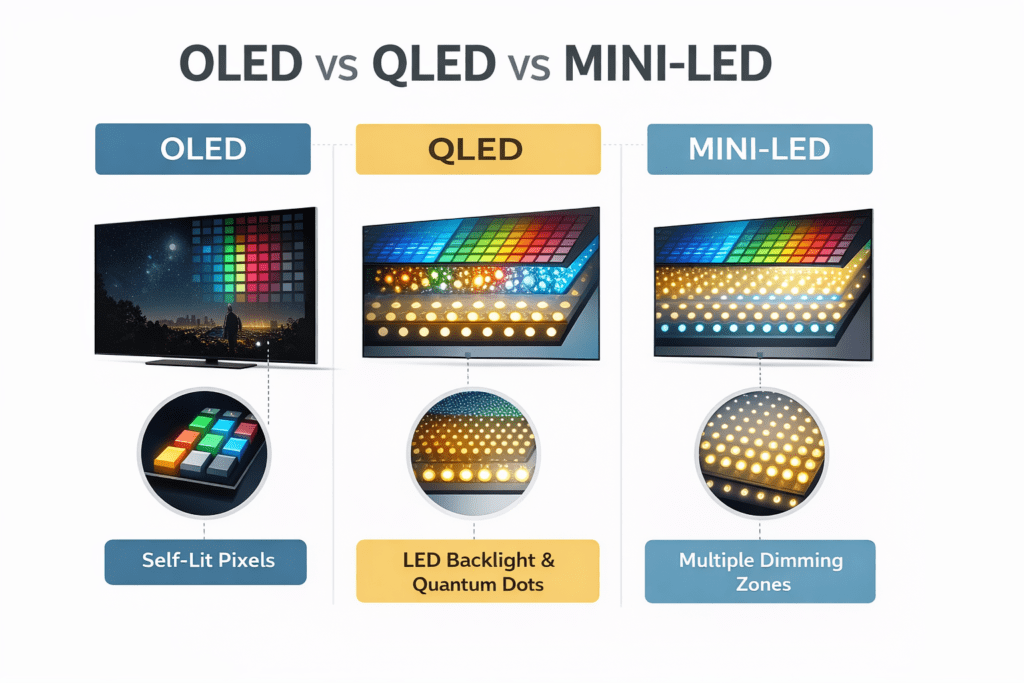
OLED is best known for deep blacks, strong contrast, and premium movie quality. It is the top choice for people who want the most refined picture.
QLED is known for brightness, vivid color, and flexible pricing. It works well for everyday use and brighter rooms.
Mini-LED sits between the two. It offers more brightness than OLED and better contrast than many standard QLED models. For many buyers, that balance makes it very appealing.
Best for Movies
For movie lovers, OLED is usually the best option. Dark scenes look more natural, and contrast feels more dramatic. Films often look more cinematic on OLED than on the other two types.
Mini-LED can still do a very good job with movies, especially if you want extra brightness. Still, OLED remains the better pick for dark-room viewing.
QLED is fine for casual movie watching, but it is not usually the first choice for people who care deeply about film quality.
Best for Bright Rooms
In a bright room, Mini-LED often wins. Its strong brightness helps the screen stay clear even when there is sunlight in the room.
QLED also works well in bright spaces and is often better than OLED for daytime use. However, Mini-LED usually gives better contrast at the same time.
OLED can still look beautiful, but it often performs best in controlled lighting rather than strong daylight.
Best for Gaming
Gamers can be happy with either OLED or Mini-LED, depending on their needs. OLED is excellent for response time, motion, and rich image quality. It feels premium and smooth.
Mini-LED is also a great gaming option, especially for people who play in bright rooms and want a stronger, brighter image. It can also be more affordable than OLED.
QLED can be good for gaming too, but the quality depends more on the specific model and features.
Best Value for Money
When it comes to value, Mini-LED often gives the best balance. It delivers strong brightness, solid contrast, and modern features without the higher price of OLED.
QLED can also offer good value, especially for buyers who want a decent TV at a lower cost. It may not match the others in contrast, but it can still be a smart choice for casual use.
OLED gives the best picture quality, but it is not always the best value for every budget.
Who Should Buy OLED
OLED is best for:
- Movie lovers
- Premium streaming
- Dark-room viewing
- Serious gamers
- Buyers who want the best picture quality
Who Should Buy QLED
QLED is best for:
- Budget-conscious buyers
- Bright-room viewing
- General TV watching
- Sports and live content
- People who want strong color and brightness at a lower price
Who Should Buy Mini-LED
Mini-LED is best for:
- Bright living rooms
- Buyers who want strong HDR
- Sports fans
- Gamers who want brightness and value
- People who want a balance between performance and price
Final Verdict
OLED vs QLED vs Mini-LED TVs is not just a technical comparison. It is really about matching the TV to your needs.
Choose OLED if you want the best overall picture quality and mainly watch movies, streaming content, or games in a dim room. Pick QLED if you want a bright and colorful TV at a lower price. Go with Mini-LED if you want strong brightness, better contrast, and excellent overall value.
For many people in 2026, Mini-LED is the smartest middle-ground choice. Even so, OLED still leads in pure picture quality, while QLED remains a solid option for affordable everyday viewing.
In the end, OLED vs QLED vs Mini-LED TVs comes down to your budget and how you use your TV daily.
For more technical details about TV display technologies, you can refer to expert guides on websites like RTINGS or TechRadar.
If you are also comparing different devices, check out our detailed guide on Chromebook vs Laptop vs Tablet to find the best option for your needs.