
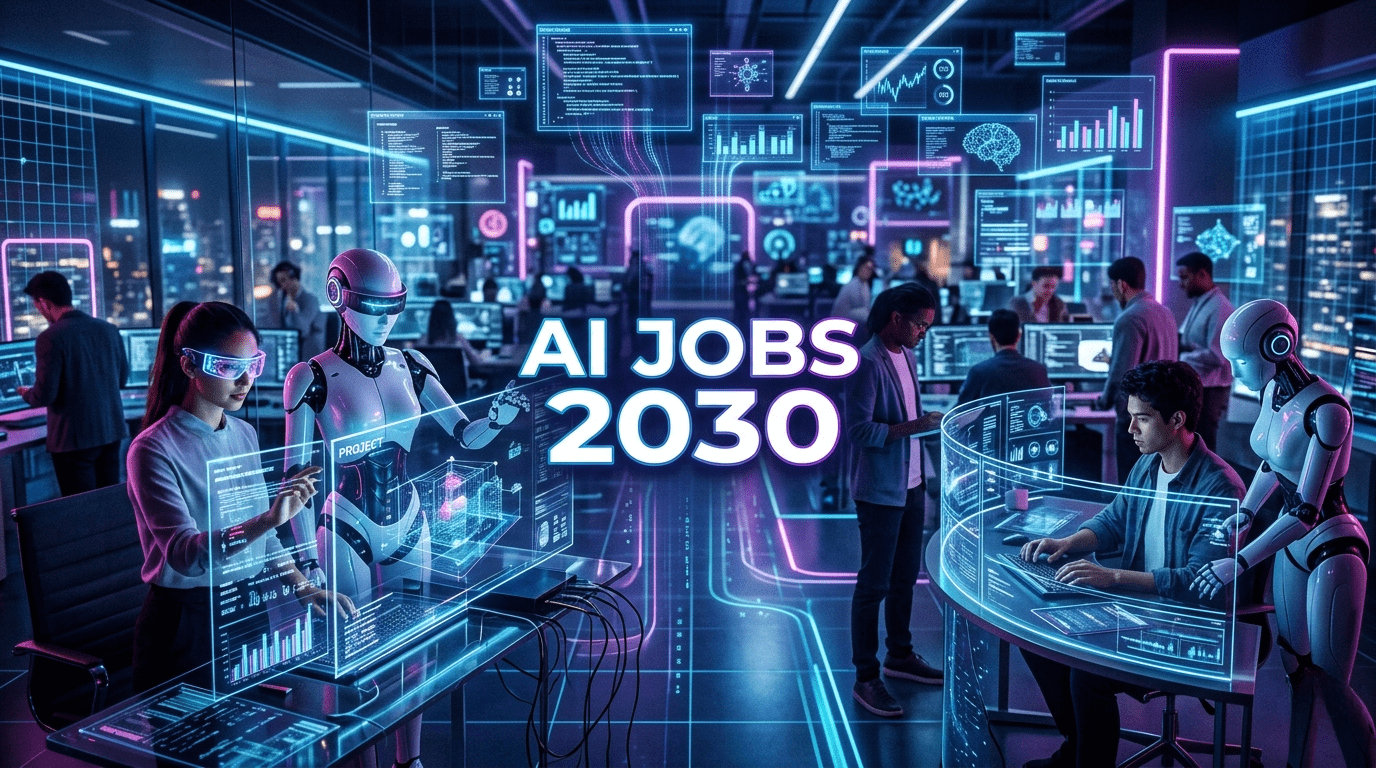
The conversation around the AI Jobs Future 2030 is growing louder every year. As artificial intelligence becomes part of everyday business operations, people everywhere are asking the same question: will AI replace human jobs or create entirely new careers? The truth is far more balanced than the headlines suggest. While some roles will disappear, many more will evolve, and brand-new opportunities will emerge across industries.
The honest answer is more complex than a simple yes or no. AI will absolutely replace some jobs. It will also create entirely new industries, roles, and opportunities, shaping the AI Jobs Future 2030. By 2030, the workplace will look very different—but not necessarily smaller. This article explores the realistic future of jobs in the AI era.
According to the World Economic Forum’s Future of Jobs Report, millions of new roles are expected to emerge alongside AI-driven automation
The Fear: Why People Think AI Will Replace Most Jobs
Fear around automation isn’t new. During the Industrial Revolution, machines replaced manual labor. Later, computers replaced many clerical roles. Today, AI feels different because it threatens both physical and cognitive work.
Large language models, generative AI, robotics, and automation tools can now:
- Write articles and marketing copy
- Generate images and videos
- Analyze legal documents
- Assist in coding and debugging
- Provide medical insights
- Automate customer support
When people see AI doing tasks once considered uniquely human, it naturally triggers concern about mass unemployment.
Reports from organizations like World Economic Forum and McKinsey & Company often highlight that millions of jobs could be disrupted by automation. Headlines sometimes amplify the worst-case scenario, making it seem like AI will replace entire professions overnight.
But history—and economics—tell a more nuanced story.
A Lesson from History: Technology Creates More Jobs Than It Destroys
Every major technological revolution has followed the same pattern:
- Old jobs disappear
- New jobs emerge
- Productivity increases
- Entire industries are born
When electricity spread across the world, lamplighters lost their jobs—but electricians, appliance manufacturers, and modern cities emerged. When the internet became mainstream, travel agents declined, but web developers, digital marketers, and content creators exploded in demand, setting the stage for the AI Jobs Future 2030 transformation.
AI is following the same pattern.
The difference is speed. AI is moving faster than past technological shifts, which means workers and businesses must adapt more quickly than ever before.
Jobs Most Likely to Be Automated by 2030
AI excels at tasks that are repetitive, predictable, and data-driven. These roles are most vulnerable:
1. Routine Administrative Roles
Tasks like scheduling, data entry, document processing, and basic reporting are already being automated by AI assistants and workflow tools.
Roles likely to shrink:
- Data entry clerks
- Basic bookkeeping roles
- Scheduling coordinators
- Transcriptionists
This doesn’t mean offices will disappear. Instead, administrative work will become more strategic.
2. Customer Support and Call Centers
AI chatbots and voice assistants are improving rapidly. Companies already use AI to handle:
- Frequently asked questions
- Order tracking
- Refund requests
- Technical troubleshooting
Companies like IBM estimate that AI can handle a large percentage of customer queries without human intervention.
However, complex and emotional interactions will still require human agents.
3. Basic Content Production
Generative AI tools can produce:
- Blog drafts
- Social media posts
- Product descriptions
- Simple graphics
Platforms from OpenAI and others have dramatically reduced the time needed to create digital content.
But here’s the key: AI replaces low-level content, not high-level creativity and strategy.
4. Repetitive Manufacturing and Logistics
Robotics and AI vision systems are transforming factories and warehouses.
By 2030, expect:
- Automated warehouses
- Autonomous delivery vehicles
- Smart manufacturing lines
Human roles will shift toward supervision, maintenance, and system optimization.
The Opportunity: Jobs AI Will Create
While automation removes tasks, it also creates entirely new job categories. Many jobs that will exist in 2030 don’t exist today.
Here are some of the fastest-growing AI-driven roles.
1. AI Trainers and Prompt Engineers
AI systems need guidance, testing, and refinement. This creates roles like:
- AI trainers
- Prompt engineers
- AI content editors
- Human-in-the-loop reviewers
These jobs focus on improving AI outputs and ensuring quality, accuracy, and safety.
Ironically, AI creates jobs that involve teaching AI how to work better.
2. AI Ethics and Governance Specialists
As AI becomes more powerful, society must manage risks such as bias, privacy, and misuse.
Expect growth in roles like:
- AI policy advisors
- AI auditors
- Algorithm bias analysts
- Responsible AI officers
Governments and companies are already investing heavily in this area.
3. Human-AI Collaboration Managers
Future workplaces won’t be human vs AI—they will be human + AI teams.
New roles will focus on:
- Designing AI workflows
- Training teams to use AI tools
- Managing productivity with AI systems
Companies will need professionals who understand both technology and human behavior.
4. AI-Enhanced Creative Roles
Instead of replacing creativity, AI is supercharging it.
Future creative jobs include:
- AI-assisted filmmakers
- Virtual world designers
- AI game narrative designers
- Synthetic media producers
Creative industries may actually expand because AI lowers production costs.
The Big Shift: Jobs Will Change, Not Just Disappear
The biggest misunderstanding about AI is the idea that it replaces entire jobs. In reality, AI replaces tasks within jobs.
For example:
Accountant (today):
- Data entry
- Spreadsheet management
- Reporting
- Financial analysis
Accountant (2030):
- AI-assisted analysis
- Strategic financial planning
- Risk management
- Business advising
The role evolves from routine work to high-value decision-making.
This pattern will happen across most professions.
Why AI Will Likely Create More Jobs Overall
Economists believe AI will increase employment in the long run for several reasons:
1. Productivity Explosion
AI dramatically increases productivity. When productivity rises:
- Companies grow faster
- Costs decrease
- New markets appear
This leads to more hiring, not less.
2. Lower Barriers to Entrepreneurship
AI reduces the cost of starting a business. A single person can now:
- Build a website
- Design branding
- Write marketing copy
- Analyze customers
- Automate operations
This will lead to a surge in small businesses and startups.
More businesses = more jobs.
3. New Industries We Can’t Predict Yet
Few people predicted social media managers, app developers, or YouTubers in 2000.
By 2030, entirely new industries will emerge around:
- Virtual worlds
- AI healthcare
- Smart cities
- Climate tech
- Personalized education
Future jobs are often invisible until technology makes them possible.
The Real Risk: Job Displacement and Reskilling
The biggest challenge isn’t job loss—it’s transition speed.
Workers in automatable roles may need to reskill quickly. Without training and support, this transition could be painful.
Governments and companies must invest in:
- Upskilling programs
- Digital literacy education
- Career transition support
The future workforce must embrace lifelong learning.
Skills That Will Be Valuable in 2030
As AI handles routine work, human skills become more important.
1. Creativity
AI generates ideas, but humans decide:
- What matters
- What resonates
- What tells a meaningful story
2. Emotional Intelligence
Jobs involving empathy, communication, and trust will thrive:
- Healthcare
- Teaching
- Leadership
- Counseling
3. Critical Thinking
AI provides information. Humans must:
- Evaluate it
- Question it
- Apply it responsibly
4. Adaptability
The most valuable skill will be the ability to learn new tools quickly.
The 2030 Workplace: What It Will Look Like
Imagine a typical office in 2030:
- Employees work alongside AI assistants
- Meetings include real-time AI summaries
- Data analysis happens instantly
- Routine tasks are automated
- Humans focus on strategy, creativity, and relationships
Instead of replacing workers, AI becomes a productivity partner.
So… Will AI Replace Jobs or Create Them?
The realistic answer:
- Some jobs will disappear
- Many jobs will change
- Entirely new careers will emerge
- Overall employment will likely grow
The future isn’t about humans vs machines.
It’s about humans who use AI vs humans who don’t.
Final Thoughts: The Future Is Not Jobless — It’s Different
AI will reshape the job market more dramatically than any technology in recent history, shaping the AI Jobs Future 2030 in ways we are only beginning to understand. But history shows that technological progress ultimately expands opportunity.
By 2030, the most successful workers won’t be those who resist AI. They will be the ones who learn to collaborate with it.
The question is no longer “Will AI take my job?”
The better question is:
“How can AI help me do my job better?”
That mindset will define the future of work.
Explore more: The $600 Billion Data Center Boom