
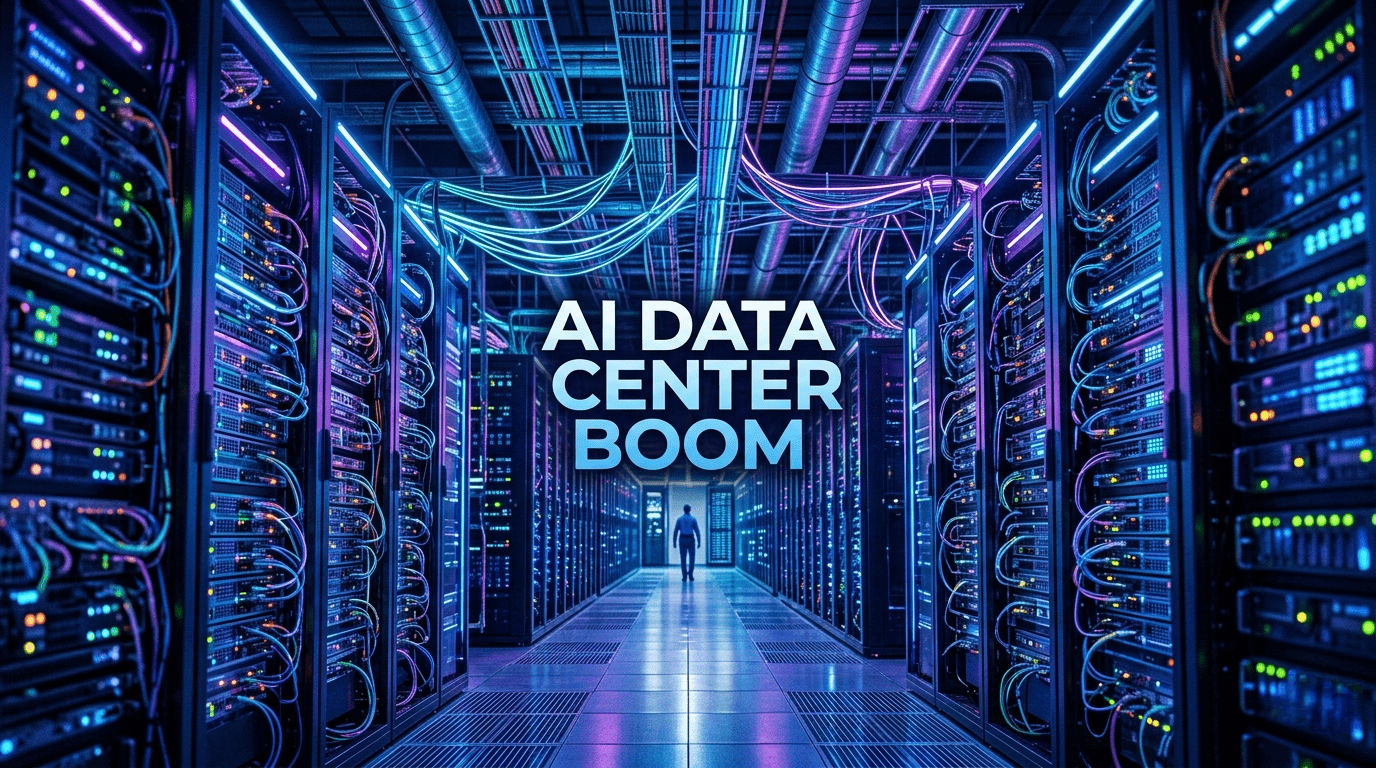
The AI data center boom is reshaping the foundations of the digital world. Artificial intelligence is no longer just software running in the cloud — it now requires massive physical infrastructure, specialized chips, and unprecedented energy resources. As companies race to build AI capabilities, global spending on data centers is accelerating toward a projected $600 billion this decade. This rapid expansion marks one of the most important technology infrastructure shifts of the modern era.
The AI revolution is forcing companies, governments, and cloud providers to rethink everything from chip design to electricity grids. The AI data center boom has turned data centers, once seen as quiet warehouses of servers, into the most strategic infrastructure of the digital age.
According to the World Economic Forum, emerging AI breakthroughs are expected to transform daily life faster than any previous technology wave.
AI Changed the Economics of Computing
For decades, data centers grew steadily alongside the internet. Social media, cloud storage, streaming, and mobile apps drove demand, but the growth curve was predictable. Artificial intelligence changed that almost overnight.
Training and running modern AI models requires a scale of computation that traditional applications never demanded. A single advanced AI model can require thousands of specialized processors running continuously for weeks or months. Once deployed, millions of users interacting with AI services generate a constant stream of inference workloads that never sleep.
Companies like OpenAI, Google, and Microsoft are now competing not just on algorithms, but on computing capacity. Access to massive computing infrastructure has become a competitive advantage as important as talent or intellectual property.
This shift has transformed data centers from a cost center into a strategic asset.
The Rise of AI Supercomputing
Traditional enterprise workloads—like databases and web hosting—were designed for CPUs. AI workloads, however, rely heavily on GPUs and specialized accelerators that can process massive amounts of data in parallel.
This is why companies such as NVIDIA have become central players in the infrastructure boom. AI chips are now the engines of modern data centers. Entire facilities are being redesigned to accommodate dense clusters of AI accelerators.
These new AI supercomputing clusters differ from traditional data centers in several key ways:
- Much higher power consumption
- Extreme cooling requirements
- Specialized networking hardware
- Massive storage throughput needs
AI training clusters often contain tens of thousands of GPUs connected with ultra-fast networking. These environments resemble scientific supercomputers more than corporate IT facilities.
Why Cloud Giants Are Spending Billions
The biggest beneficiaries—and investors—in this boom are cloud providers. Companies like Amazon Web Services, Microsoft Azure, and Google Cloud are racing to build AI-ready infrastructure at unprecedented speed.
The reason is simple: demand for AI computing has exploded faster than anyone predicted. Every startup, enterprise, and research lab wants access to AI compute, but very few can afford to build their own facilities. That makes cloud providers the gatekeepers of AI capacity.
This has triggered an infrastructure arms race. Cloud companies are:
- Building new mega-data centers
- Expanding existing campuses
- Investing in custom AI chips
- Securing long-term energy contracts
What once took years to plan is now happening in months.
The Power Problem: AI’s Massive Energy Appetite
One of the biggest challenges in the AI infrastructure boom is electricity.
Data centers already consumed a significant portion of global electricity before AI arrived. AI workloads multiply those energy demands dramatically. Training a large AI model can consume as much electricity as thousands of homes use in a year.
As a result, energy availability is now a key factor in deciding where data centers are built. Locations are chosen based on:
- Access to renewable energy
- Proximity to power grids
- Climate conditions for cooling
- Government incentives
Tech companies are signing massive renewable energy agreements and investing heavily in solar, wind, and nuclear projects. In many regions, data center expansion is directly influencing national energy strategies.
AI is not just reshaping the tech industry—it is reshaping energy infrastructure.
The Cooling Revolution
Heat has always been a challenge in computing, but AI has pushed cooling requirements to new extremes.
High-density GPU clusters generate enormous heat, and traditional air cooling is no longer sufficient. This has led to a rapid shift toward liquid cooling technologies.
New data centers increasingly use:
- Direct-to-chip liquid cooling
- Immersion cooling systems
- Advanced airflow engineering
Liquid cooling allows servers to operate more efficiently while reducing power consumption. This innovation is becoming essential for sustaining the next generation of AI workloads.
The future of computing infrastructure may look more like an industrial cooling plant than a traditional server room.
AI Is Driving a New Kind of Hardware Innovation
The AI boom has also sparked a wave of innovation in hardware design. Companies are developing custom chips optimized for specific AI workloads.
These include:
- AI training accelerators
- Inference-optimized processors
- High-bandwidth memory systems
- Specialized networking hardware
This shift marks the end of the “one-size-fits-all” era of computing. Future data centers will be built around heterogeneous architectures—collections of specialized processors working together.
The result is faster performance, lower energy consumption, and systems designed specifically for AI workloads.
Data Sovereignty and the Rise of Regional Data Centers
Governments around the world are becoming increasingly concerned about where data is stored and processed. AI systems often rely on sensitive personal, financial, and national data, making data sovereignty a major political issue.
Countries now want:
- Local data processing
- Regional cloud infrastructure
- Stronger control over digital ecosystems
This has led to a global expansion of regional data centers. Instead of a few centralized hubs, the world is moving toward a distributed network of AI-ready infrastructure.
This trend is reshaping global technology geography and creating new opportunities in emerging markets.
The Real Estate Boom Nobody Expected
The demand for data center space has created an unexpected surge in digital real estate.
Large facilities require:
- Vast land areas
- Proximity to power and fiber networks
- Stable climates and infrastructure
Real estate developers are now specializing in data center campuses. Entire industrial zones are being repurposed for AI infrastructure.
In many regions, data centers are becoming as economically important as factories once were.
Edge Computing Joins the AI Infrastructure Wave
While mega-data centers are growing rapidly, AI is also pushing computing toward the network edge.
Edge data centers process information closer to users, reducing latency and bandwidth costs. This is essential for applications like:
- Autonomous vehicles
- Smart cities
- Industrial automation
- Augmented reality
The future infrastructure landscape will likely combine massive centralized AI clusters with thousands of smaller edge facilities.
AI is expanding computing both outward and inward at the same time.
The Geopolitical Dimension of AI Infrastructure
AI infrastructure has become a matter of national strategy. Countries recognize that access to computing power will influence economic growth, innovation, and security.
Governments are investing in:
- National AI supercomputers
- Domestic semiconductor production
- Local cloud infrastructure
- Strategic partnerships with tech firms
Infrastructure that once seemed purely technical is now tied to geopolitical competition.
The global race for AI leadership is increasingly a race for computing capacity.
Environmental Concerns and Sustainable Innovation
The scale of AI infrastructure growth has raised environmental concerns. Critics worry about energy use, water consumption, and carbon emissions.
In response, the tech industry is investing in sustainability initiatives:
- Renewable energy adoption
- Water-efficient cooling systems
- Energy-efficient chip design
- Carbon-neutral data center goals
Sustainability is becoming a competitive differentiator during the AI data center boom. Companies that build efficient, environmentally responsible infrastructure may gain both regulatory and public support.
The Future of Data Centers in the AI Era
The data center of the future will look dramatically different from the facilities of the past.
We can expect:
- AI-designed infrastructure layouts
- Fully automated operations
- Advanced robotics for maintenance
- Autonomous energy optimization systems
Data centers are evolving into intelligent infrastructure capable of managing itself.
In many ways, AI is now building the very infrastructure that powers AI.
Final Thoughts
The $600 billion AI data center boom represents one of the largest infrastructure transformations in modern history. Artificial intelligence has fundamentally changed what computing requires, how infrastructure is designed, and where investment is flowing.
This shift reaches far beyond the tech industry. It affects energy grids, real estate, geopolitics, sustainability, and the future of work.
For decades, software defined the digital economy. In the coming years, physical computing infrastructure will define who leads it.
The AI revolution is not just happening in code—it is being poured in concrete, wired with fiber, and powered by entire power plants.
You may also like reading: Top AI Innovations That Will Change Everyday Life


One Comment